 |
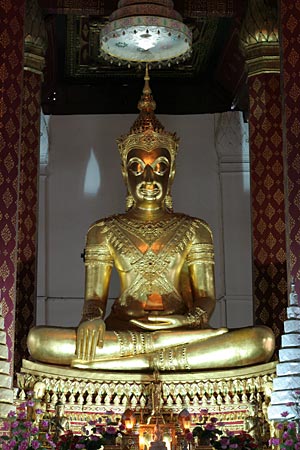
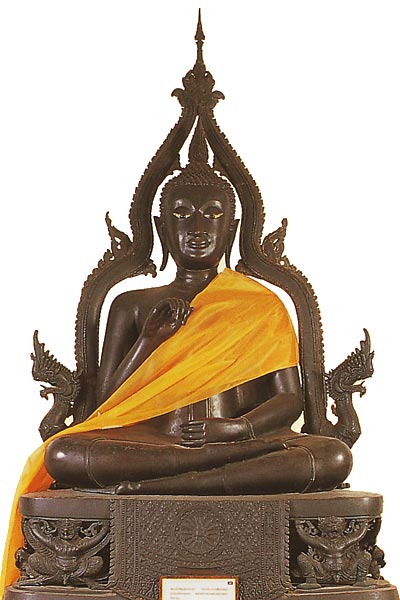
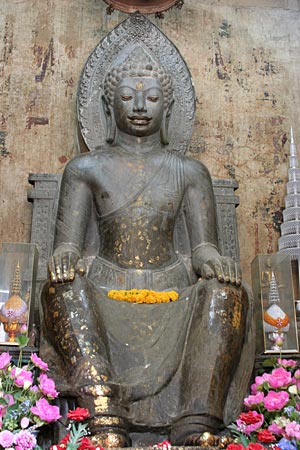
Dvaravati art - Buddha Image at Wat Na Phramen, Ayutthaya. Notice that the Buddha is seated in the 'European style'. The Buddha displays none of the 'classical' mudras, and His Hands are laying peacefully palms down on His Knees.
|
|
Dvaravati refers to a kingdom situated in the Chao Phraya river basin between the 7th and 11th centuries A.D. Presently Dvaravati art, including many Buddha images and sculptures, can be found at National Museum in many provinces of Central Thailand, such as Phra Pathom Chedi National Museum, Nakhon Pathom, U Thong National Museum (Suphan Buri), Prachinburi National Museum. All the above mentioned National Museums are certainly worth a visit.
The Dvaravati style derived from Indian archetypes such as Amaravati and Gupta styles, and were integrated with local art.
Dvaravati art and images went roughly through three stages : In the initial stage, there was heave Indian influence, later on the art became more independent locally, and still later influence of Khmer art is visible. So, initially the faces depicted would resemble Indian sculptures. Later on, influenced by local styles, the aureole would appear in a lotus bud shape or orb over the cranial protuberance. Large hair curls are visible, and the eyebrows would resemble a crows wings curve, like a flying bird. Protuding eyes, with flat nose and thick lips are common. Standing Buddha images performing the Vitarka (Preaching) posture, with robes hanging to mid shin level (see example). In sitting images, a short mantle is placed over the left shoulder.
Khmer influence became visible later on with a more square face and cleft chin. The Dharmachakra wheel (see picture at bottom) is very typical of Dvaravati art. The wheel was likely positioned on large pillars at places of worship. The Dharmachakra wheel symbolizes the Buddha's turning of the Wheel of Truth or Law. Often the Dharmachakra has eight spokes, symbolizing the eight-fold Noble Path. The Buddha is known as the Wheel-Turner : the One who sets the cycle of teachings in motion and in consequence changes the course of destiny.
It is worth remembering that during the early centuries of Buddhism, no sculptures of the Buddha were made, and the Buddha was represented by various symbols such as the Dharmachakra, the Bodi Tree, the Buddha's footprints etc.
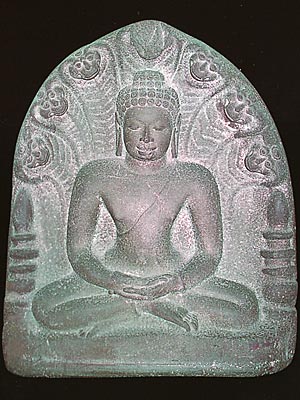 |
Dvaravati art - Buddha, protected by Naga in meditation posture. 8 - 11 th century A.D.
Found at Si Mahosot, Prachinburi province.
Now in the National Museum, Bangkok.
|
|
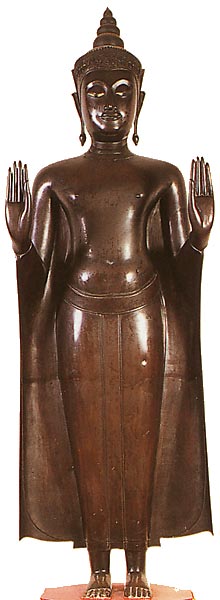
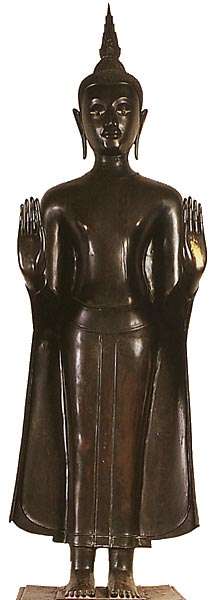
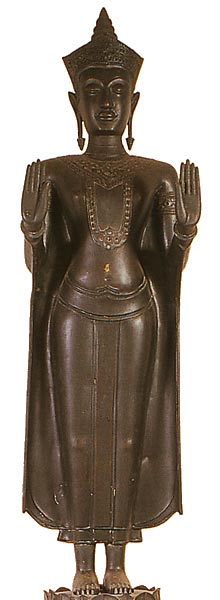
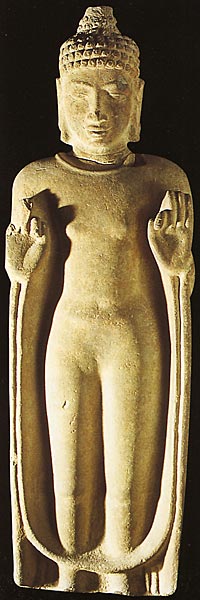 | Dharavati art - Standing Buddha with two hands displaying Vitarka Mudra. 7- 9 th century A.D.
Found at Si Mahosot.
Now present at National Museum, Prachinburi. |
|
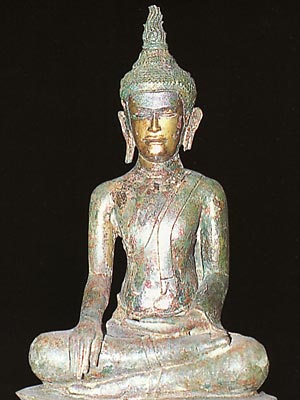
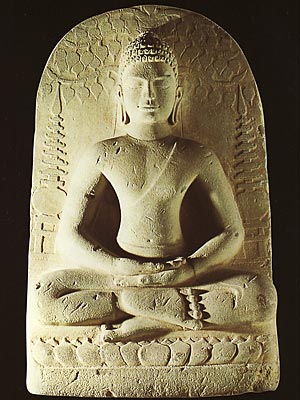 | Dvaravati art - Sitting Buddha in Meditation Posture.
8 - 10th century A.D.
Found at Si Mahosot, Prachinburi province.
Now present at National Museum, Prachinburi. |
|
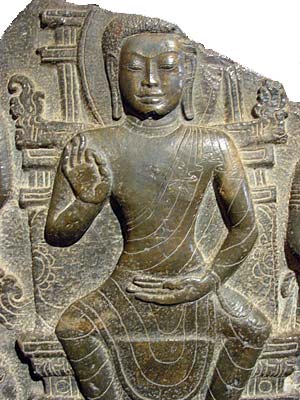 | Stone carving of scene from the Buddha's life. Dvaravati art 7th-11th century A.D. The Lord Buddha is seated in so-called 'European' fashion.
Phra Pathom Chedi National Museum (Nakhon Pathom)
Original found at Wat Sai, Nakhon Pathom |
|
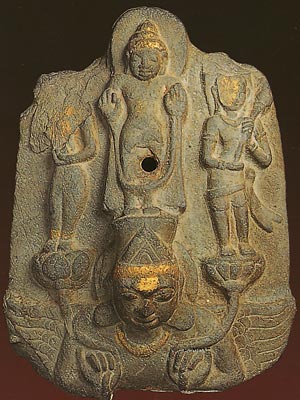 | Dvaravati art - Buddha standing on Arunaditya.
7 - 11th century A.D.
Found at Nakhon Pathom.
Now present at Phra Pathom Chedi National Museum, Nakhon Pathom.
|
|
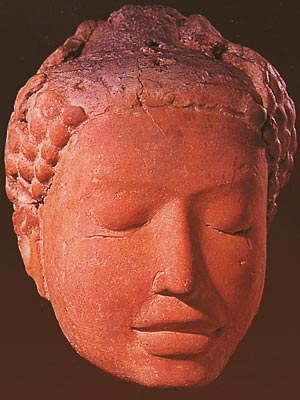 | Dvaravati art - Head of the Buddha
17 cm high Terracotta image.
Found at Wat Phra Ngam, Nakhon Pathom.
Now present National Museum, Bangkok. |
|
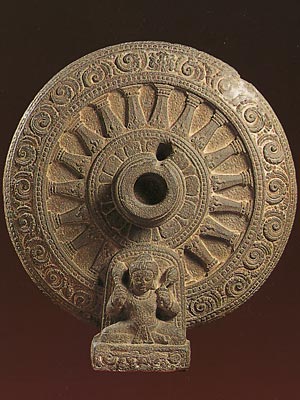 | Dvaravati art - Dharmachakra
7- 11th century A.D.
Found at Nakhon Pathom. |
|
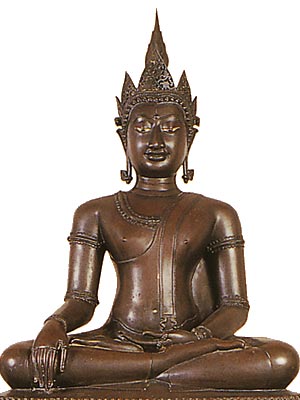
Khmer-Lopburi Lopburi art goes back to the 11-13th century A.D. Lopburi was a provincial capital during the Khmer empire. At times it experiences periods of independence, but its art form and Buddha images display Khmer influence.
Buddha images often display a cranial protuberance in the form of three tiered lotus petals. A hair band is featured, and the hair of the Buddha can be straight like human hair. The head is often decorated with a diadem of face frame. Thick lips, a smiling face, prominent earlobes are featured.
A robe is draped diagonally with a straight edged mantle over the left shoulder, extending to the navel. Often the Buddha image is displayed on a lotus petal base. Seated Naga protected Buddha images in the meditation posture are common. Sometimes the Naga protected Buddha appears with Royal ornaments, and has a more stern facial expression. Ching Saen-Lanna 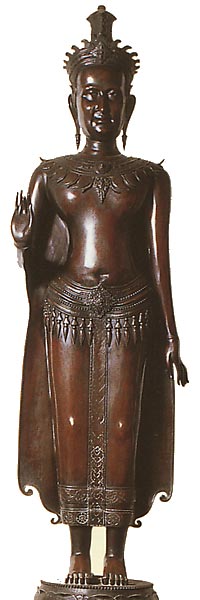 | Buddha, wearing the attributes of Royalty, in the Khmer style of the Lopburi period.
With the gesture (see right hand) of preaching. Cast and enlarged from an old model.
Image present in the cloister of the Ubosoth at Wat Benchamabophit, Bangkok. |
|
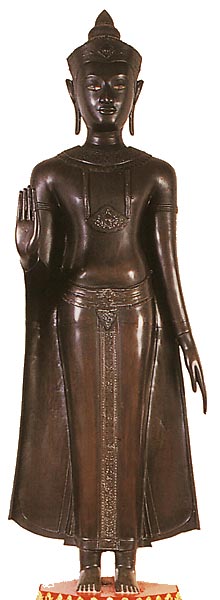 | Standing Buddha image, with the gesture of forbidding the relatives from fighting.
In the style of the Lopburi period.
Found in Phetchaburi province.
Image present in the cloister of the Ubosoth at Wat Benchamabophit, Bangkok. |
|
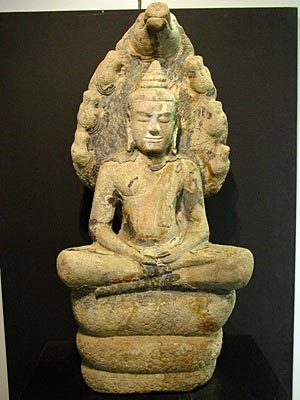 | National Museum Prachinburi
Naga protected Buddha image. Notice the cranial protuberance in the form of three tiered lotus petals. |
|
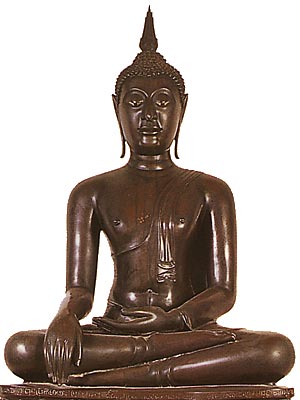 | Sitting Buddha with the gesture of Subduing Mara.
In the Khmer style.
Found at Wat Si Chin, Thonburi.
Image present in the cloister of the Ubosoth at Wat Benchamabophit, Bangkok. |
|
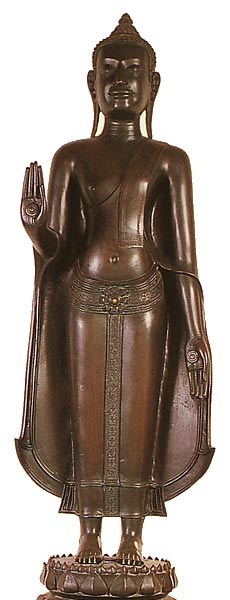 | Standing Buddha image, with the gesture of Forbidding the Relatives from Fighting.
In the style of the Lopburi period.
Cast and enlarged from an ancient model.
Image present in the cloister of the Ubosoth at Wat Benchamabophit, Bangkok. |
|
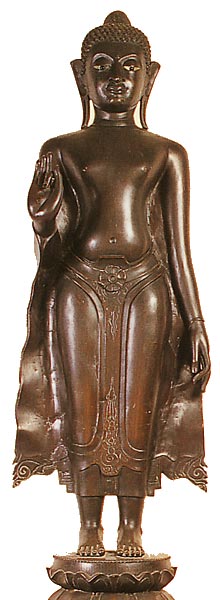 | Standing Buddha image, with the gesture of Forbidding the Relatives from Fighting.
In the style of the Lopburi period.
Cast and enlarged from an ancient model.
Image present in the cloister of the Ubosoth at Wat Benchamabophit, Bangkok. |
|
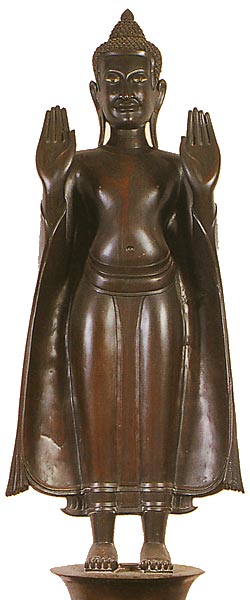 | Standing Buddha, with the gesture of Calming the Ocean.
In the style of the Lopburi period.
Cast and enlarged from an ancient model.
Image present in the cloister of the Ubosoth at Wat Benchamabophit, Bangkok. |
|
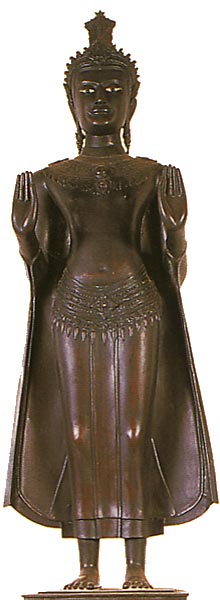 | Standing Buddha image, with the gesture of Calming the Ocean.
In the style of the Lopburi period.
Cast and enlarged from an ancient model.
Image present in the cloister of the Ubosoth at Wat Benchamabophit, Bangkok. |
|
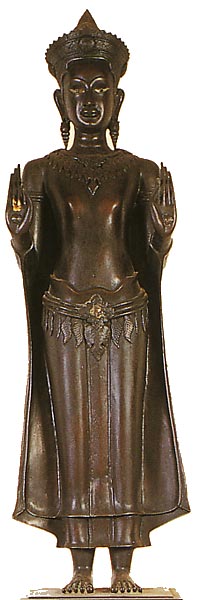 | Standing Buddha image, with the gesture of Calming the Ocean.
In the style of the Lopburi period.
Cast and enlarged from an ancient model.
Image present in the cloister of the Ubosoth at Wat Benchamabophit, Bangkok. |
|
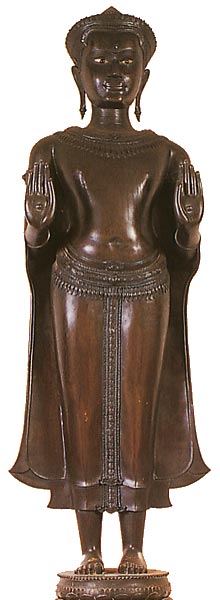 | Standing Buddha image, with the gesture of Calming the Ocean.
In the Khmer style of the Lopburi period.
Cast and enlarged from an ancient model.
Image present in the cloister of the Ubosoth at Wat Benchamabophit, Bangkok. |
|
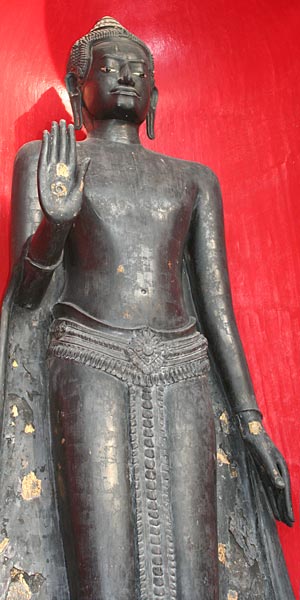 | Standing Buddha image, with the gesture of Forbidding the Relatives from Fighting.
Wearing the attributes of Royalty.
In the style of the Lopburi period.
From Wat Tewarat, Bangkok.
Image present in the courtyard behind the Ubosoth at Wat Benchamabophit, Bangkok. |
|
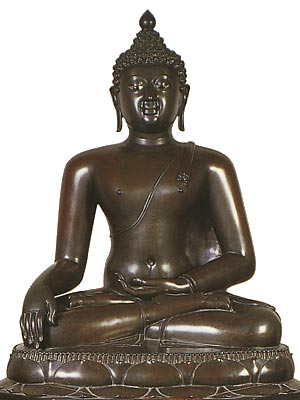
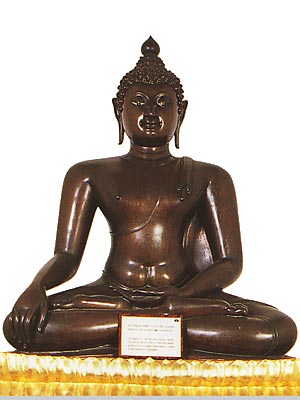
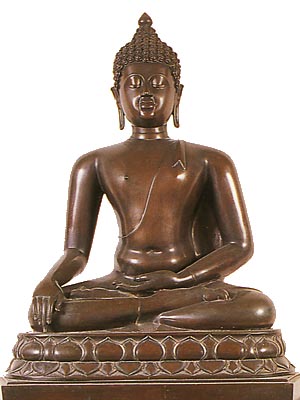
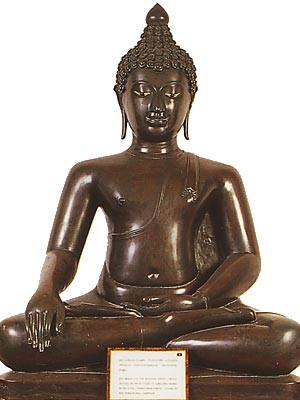
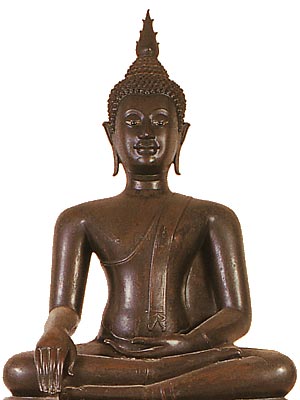
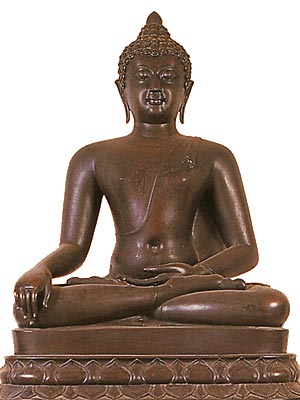
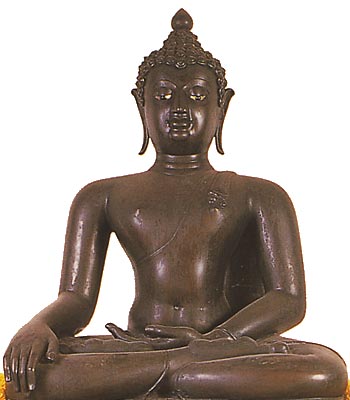
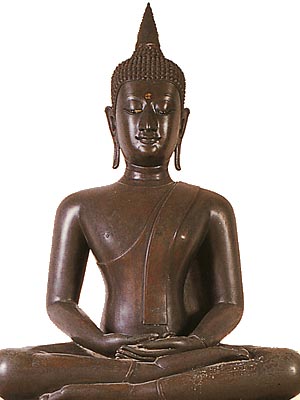
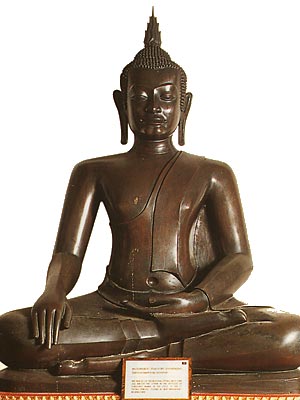
Sukhothai The Kingdom of Sukhothai had important contacts with Sri Lanka. Thai monks travelled to Sri Lanka for further religious instruction, and Sri Lankan monks settled in Sukhothai. Sukhothai religious art was thus influenced by Sri Lankan art. The Buddha images of the Sukhothai era gained important disdinguishing characteristics from the images during the Khmer and Mon era.
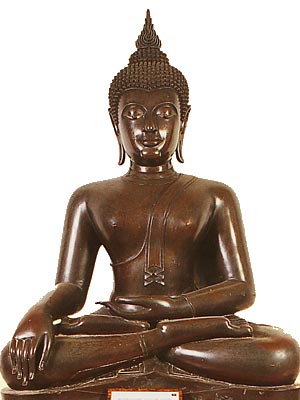
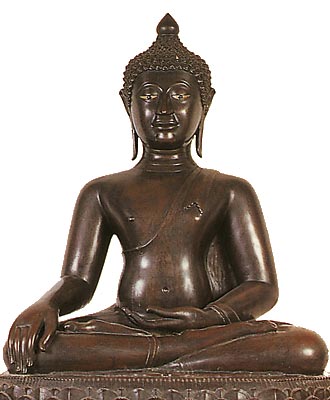
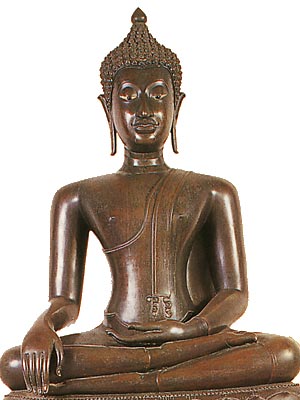
A flame appeared on top of the head of the Buddha. The head is covered with fine curled hair. The face is oval, with high curving eyebrows, a hooked nose, a downward gaze, and overall displays a gentle smiling expression.
The body of the Buddha images displays broad shoulders and a small waist.
Overall it can be said that the Buddha Images do not appear human, but display idealistic or superhuman characteristics.
During the Sukhothai era, the four postures of the Buddha (sitting, standing, walking, reclining) were created.
Buddha images of the Sukhothai era are subdivided in several groups.
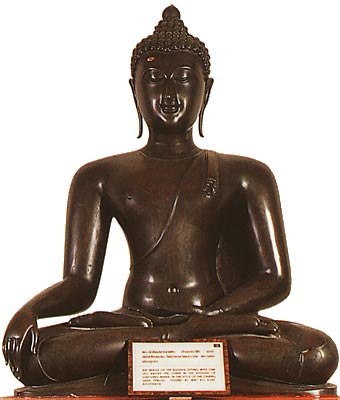
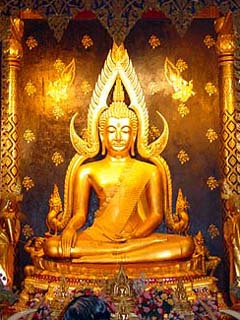
The image right below here displays Phra Phuttha Chinnarat image in Phitsanulok. It belongs to the Phra Phuttha Chinnarat group of images. Notice that the face is more rounded with a flame shaped aureole. The fingers on each hand are of equal lenght. Sitting Buddha images of the Sukhothai period most often display meditation posture, or the gesture of Subduing Mara. Walking Buddhas display the gesture of dispelling fear (Abhaya Mudra), or giving instruction (Vitarka Mudra).  | Phra Phuttha Chinnarat at Wat Phra Sri Rattana Mahathat in Phitsanulok.
This Buddha image is generally regarded to be the 'second most' important Buddha image in Thailand.
[The Emerald Buddha at Wat Phrakaew in Bangkok is probably the most important]
A replica of Phra Phuttha Chinnarat is present as the main Buddha image at Wat Benchamabophit in Bangkok.
|
|
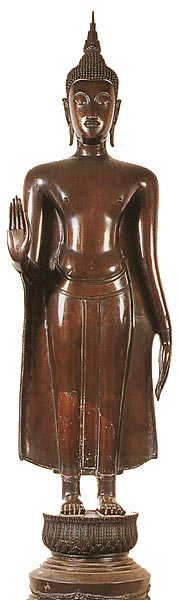 | Standing Buddha, with the gesture of forbidding the relatives from fighting each other.
In the style of the Sukhothai period.
Found at Wat Bang Oi Chang, Nonthaburi province.
Image present in the cloister of the Ubosoth at Wat Benchamabophit, Bangkok. |
|
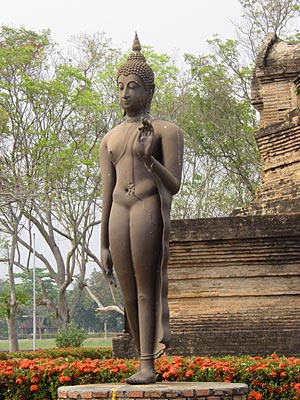 | Walking Buddha, Sukhothai Historical Park |
|
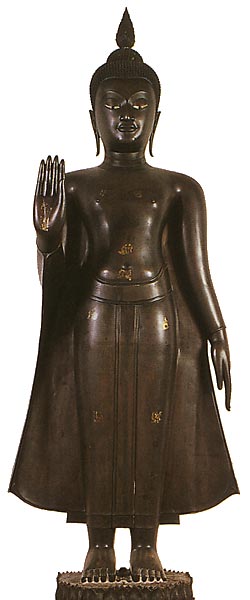 | Standing Buddha image, with the gesture of Forbidding the Relatives from Fighting.
In the style of the Sukhothai period.
Found at Wat Mai Nakhon Luang, Ayutthaya province.
Image present in the cloister of the Ubosoth at Wat Benchamabophit, Bangkok. |
|
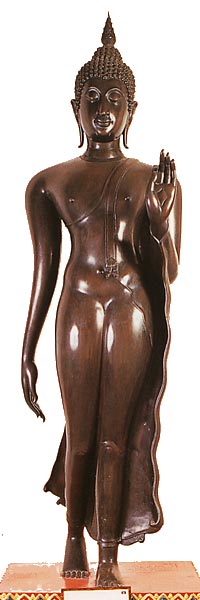 | Walking Buddha image with the gesture of Imparting Fearlessness.
In the style of the Sukhothai period.
From Wat Mahathat, Bangkok.
Image present in the cloister of the Ubosoth at Wat Benchamabophit, Bangkok. |
|
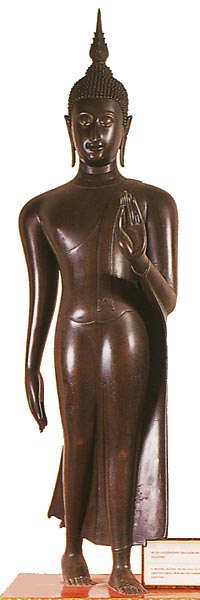 | Walking Buddha, with the gesture of Imparting Fearlessness.
In the style of the Sukhothai period.
From Wat Ratchathani, Sukhothai province.
Image present in the cloister of the Ubosoth at Wat Benchamabophit, Bangkok. |
|
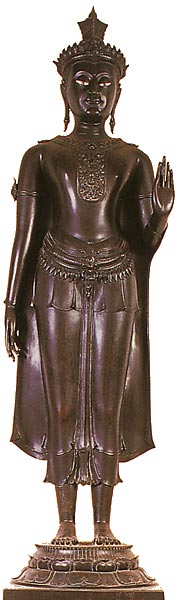 | Standing Buddha image, with the gesture of Imparting Fearlessness.
In the style of the Sukhothai period.
Cast and enlarged from an ancient model.
Image present in the cloister of the Ubosoth at Wat Benchamabophit, Bangkok. |
|
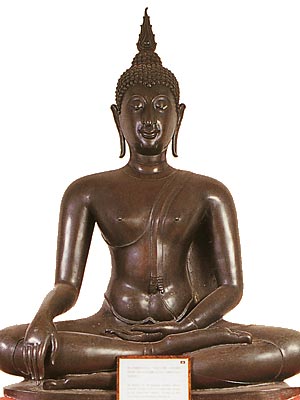 | Sitting Buddha image, with the gesture of Subduing Mara.
In the style of the Sukhothai period.
Found at Wat Praya Krai (Jotanaram), Bangkok.
Image present in the cloister of the Ubosoth at Wat Benchamabophit, Bangkok. |
|
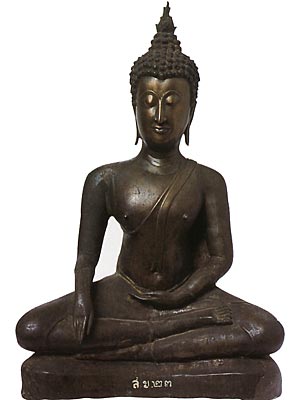 | Buddha Image with the Gesture of Subduing Mara.
(15th century A.D.)
National Museum Prachinburi |
|
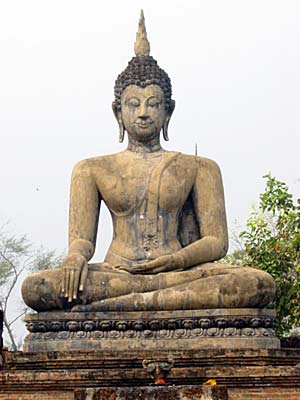 | Buddha at Wat Mahathat, Sukhothai |
|
|
 The vast majority of the Thai populations adheres to Theravada Buddhism. The Thais count their years in the Buddhist Era. At present we are in the year 2549. The Buddhist calendar is 543 years ahead of the Christian calendar, and the Buddhist era started with the passing away of the Buddha. (the Buddhist era starts one year earlier in Sri Lanka and Myanmar)