Tuesday, August 28, 2007

Buddhism in Thailand

Buddhism in Thailand

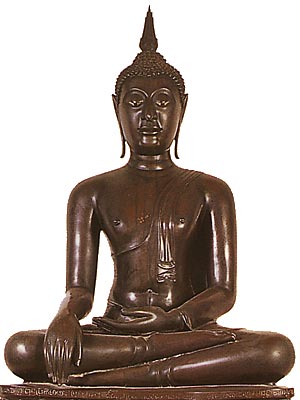
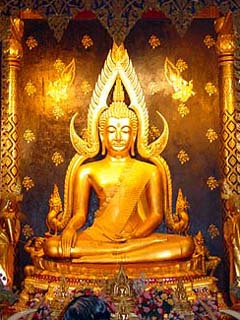
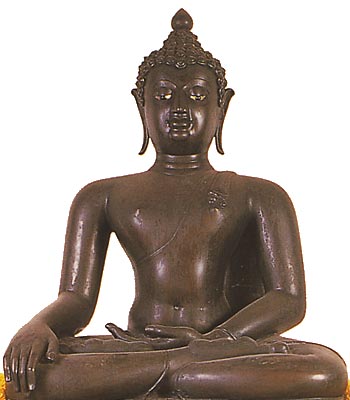
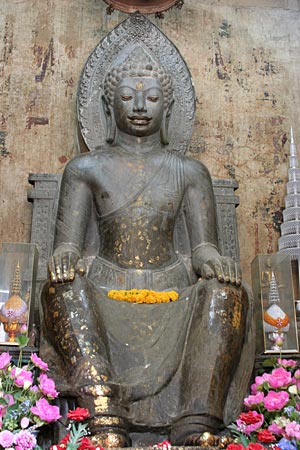
Phra Buddha Chinnarat, Phitsanulok, Northern Thailand The vast majority of the Thai populations adheres to Theravada Buddhism. The Thais count their years in the Buddhist Era. At present we are in the year 2549. The Buddhist calendar is 543 years ahead of the Christian calendar, and the Buddhist era started with the passing away of the Buddha. (the Buddhist era starts one year earlier in Sri Lanka and Myanmar)

Scientifically speaking, Gaudama Buddha is a historical figure, though his exact date and year of birth is not clearly established. The Buddha started his life as Prince Siddharta, and was born in Lumbini (presently located in Nepal). Initially he led a well protected life inside the palace grounds, until at the age of 29 while wandering outside he palace, he encountered the sufferings of old age, disease, poverty and human decay in general. He set out on a long solitary journey, and left all his possessions behind. He grew tired and renunciated all worldly pleasures, realizing that all these never lasted long and that life was in fact full of sufferings. By doing so, he intended to discover the Ultimate Truth of the whole existence, so as to find a sure way out of all suffering.

He spent his time meditating in solitude, and doing everything which he believed to lead him to success, for instance, starving and torturing himself until he become weak and thin. After his self-mortifications, he finally found that the best way to success was 'The Middle Way', that is : avoiding the two extremes of indulging oneself in pleasures or torturing oneself to the utmost. He became enlightened in one full-moon night under the Bodhi three on the bank of Nerunjara River, in the state of Magadha, when he was thirty-five years old, after spending six years altogether in search of truth.

Historical Periods:

Dvaravati


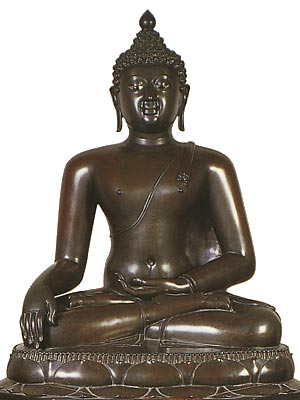
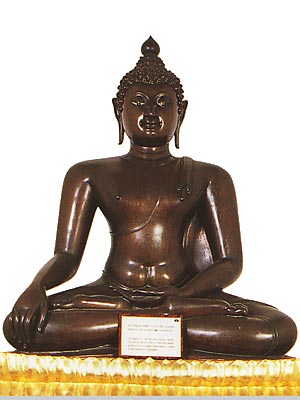
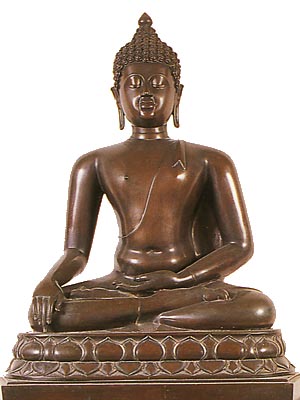
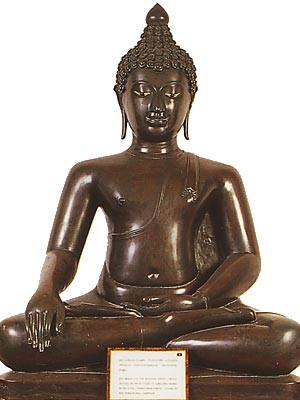
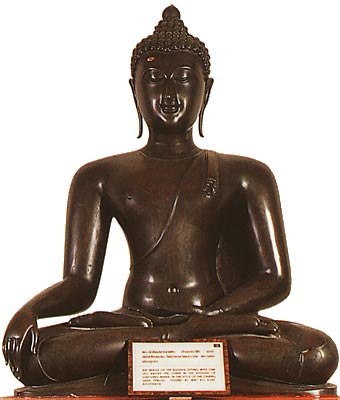
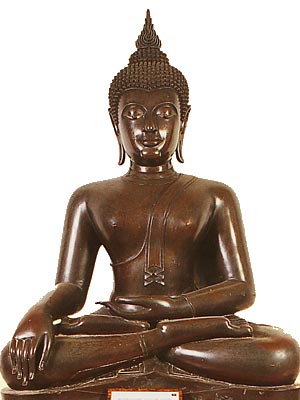
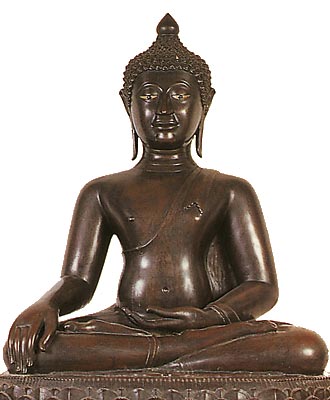
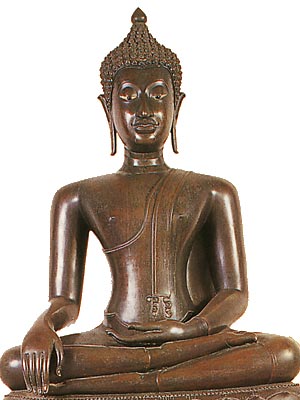
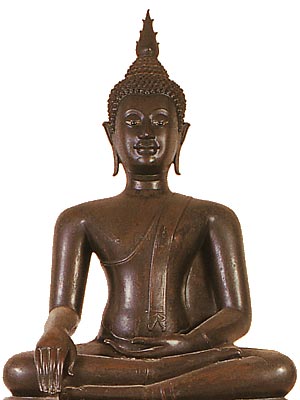
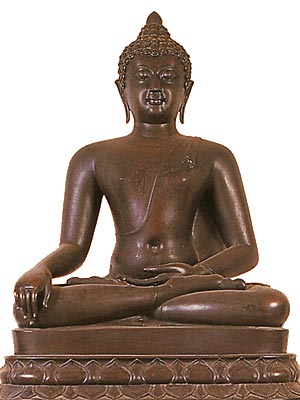
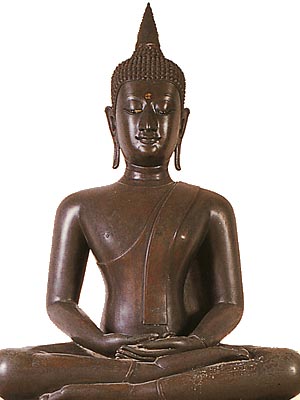
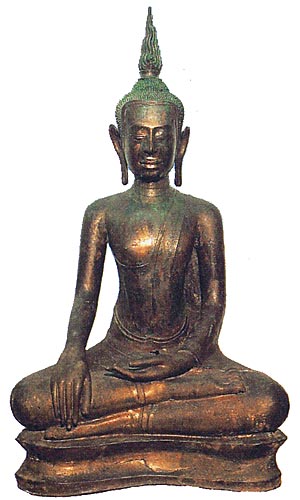
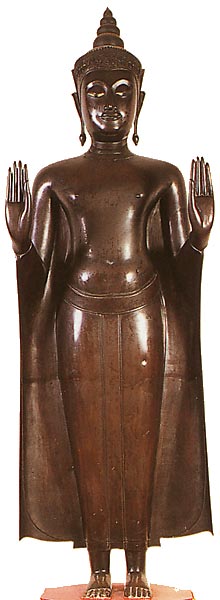
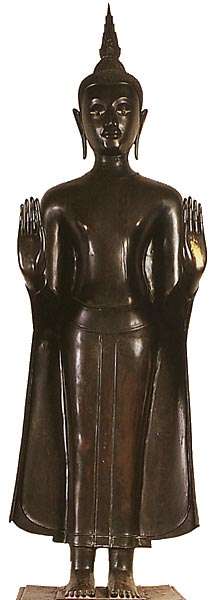
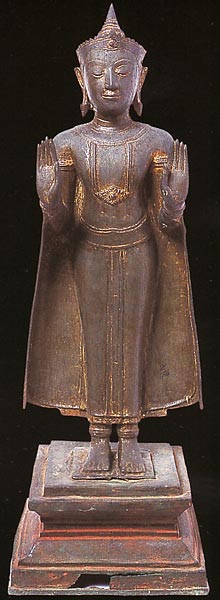
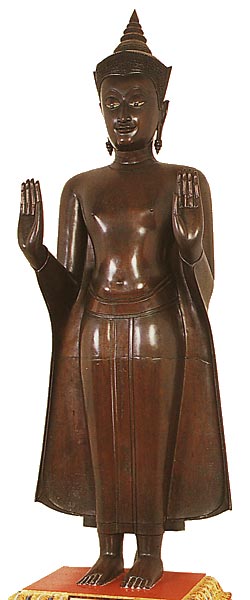
The Chiang Saen or Lanna style (between 11th and 18th centuries A.D.) was influenced by the styles of the Khmer, Sukhothai, India, Burma and Sri Lanka.
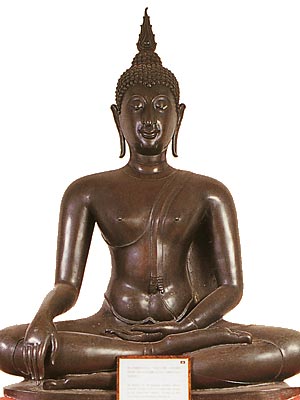
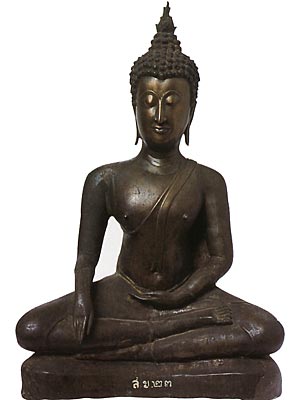
Buddha images typically feature a lotus bud or orb shaped finial and large hair curls. The torso is plump, with a slim waist line. The face is round and smiling, with high curving highbrows, a hooked nose and mostly narrow lips.
In later period, under influence of Sukhothai, the head had finer hair curls, an extended lotus shaped or flame shaped finial, and a thin hair band. As with Sukhothai Buddha images, the face became more oval.
The mantle often extended down to the navel.
Sitting Buddhas mostly display the gesture of Subduing Mara. Standing Buddhas often display the gesture of Dispelling Fear or Instruction.

Su

Chiang Saen, Buddha Images, Subduing Mara
Phra Sakyasingh.
Displaying the gesture of Subduing Mara.
In the style of the Chiang Saen period, found at Chiang Saen, Chiang Rai province.
Image present in the cloister of the Ubosoth at Wat Benchamabophit, Bangkok.

Subduing Mara, Chiang Saen, Lanna, Buddha Images
Buddha with the gesture of Subduing Mara.
In the style of the Chiang Saen period.
Found at Wat Bang Phlu, Thonburi.
Image present in the cloister of the Ubosoth at Wat Benchamabophit, Bangkok.

Subduing Mara, Chiang Saen, Buddha Images

Buddha sitting with the gesture of Subduing Mara.
In the style of the Chiang Saen period.
Found at Wat Siri Panya.
Image present in the cloister of the Ubosoth at Wat Benchamabophit, Bangkok.

Subduing Mara, Chiang Saen, Lanna, Buddha Images
Sitting Buddha, with the gesture of Subduing Mara (Calling the Earth to Witness).
In the style of the Chiang Saen period.
Found at Wat Phra Kong, Lamphun province.
Image present in the cloister of the Ubosoth at Wat Benchamabophit, Bangkok.

Chiang Saen, Buddha Iconography, Lanna
Sitting Buddha image, with the gesture of Subduing Mara.
In the style of the Chiang Saen period.
Found at Wat Ko Koet, Ayutthaya province.
Image present in the cloister of the Ubosoth at Wat Benchamabophit, Bangkok.

Chiang Saen, Buddha Iconography, Lanna
Sitting Buddha image, with the gesture of Subduing Mara.
In the style of the Chiang Saen period.
Found at Wat Luang, Phayao province.
Image present in the cloister of the Ubosoth at Wat Benchamabophit, Bangkok.

Subduing Mara, Chiang Saen, Lanna, Buddha Images

Sitting Buddha image, with the gesture of Subduing Mara.
In the style of the Chiang Saen period.
Found in Chiang Mai province.
Image present in the cloister of the Ubosoth at Wat Benchamabophit, Bangkok.

Wat Benchamabophit, Subduing Mara, Chiang Saen, Buddha images
Sitting Buddha image, with the gesture of Subduing Mara.
In the style of the Chiang Saen period.
Found at Wat Phra Bat Tak Pha, Lamphun province.
Image present in the cloister of the Ubosoth at Wat Benchamabophit, Bangkok.

Chiang Saen, Buddha Images, Iconography

Sitting Buddha image, with the gesture of Subduing Mara.
In the style of the Chiang Saen period.
Found at Wat Phra Bat Tak Pha, Lamphun province.
Image present in the cloister of the Ubosoth at Wat Benchamabophit, Bangkok.

Chiang Saen, Buddha Images, Subduing Mara

Sitting Buddha image, with the gesture of Subduing Mara.
In the style of the Chiang Saen period.
Found at Wat Sawang Arom, Muang Thung Yang, Uttaradit province.
Image present in the cloister of the Ubosoth at Wat Benchamabophit, Bangkok.

Calling the Earth to Witness, Chiang Saen, Lanna, Buddha Images

Sitting Buddha image, with the gesture of Subduing Mara.
In the style of the Chiang Saen period.
Found at Wat Arun, Thonburi.
Image present in the cloister of the Ubosoth at Wat Benchamabophit, Bangkok.

Meditation, Chiang Saen, Buddha images

Sitting Buddha image, with the gesture of Meditation.
In the style of the Chiang Saen period.
Found at Chiang Saen, Chiang Rai province.
Image present in the cloister of the Ubosoth at Wat Benchamabophit, Bangkok.

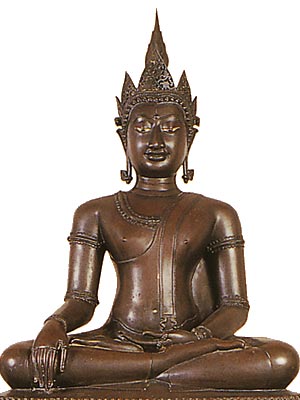
Royal Attributes, Chiang Sean, Buddha Images
Sitting Buddha image, with the gesture of Subduing Mara.
Wearing the attributes of Royalty.
In the style of the late Chiang Saen period.
Found at Wat Mahathat Haripunchai, Lamphun province.
Image present in the cloister of the Ubosoth at Wat Benchamabophit, Bangkok.

Buddha at Wat Na Phramen, Ayutthaya, Dvaravati Art

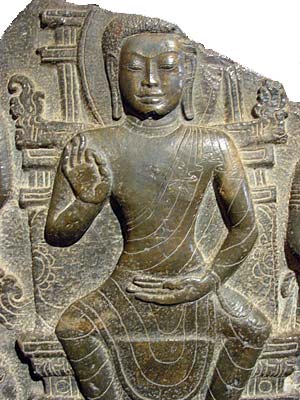
Dvaravati art - Buddha Image at Wat Na Phramen, Ayutthaya. Notice that the Buddha is seated in the 'European style'. The Buddha displays none of the 'classical' mudras, and His Hands are laying peacefully palms down on His Knees.

Dvaravati refers to a kingdom situated in the Chao Phraya river basin between the 7th and 11th centuries A.D. Presently Dvaravati art, including many Buddha images and sculptures, can be found at National Museum in many provinces of Central Thailand, such as Phra Pathom Chedi National Museum, Nakhon Pathom, U Thong National Museum (Suphan Buri), Prachinburi National Museum. All the above mentioned National Museums are certainly worth a visit.
The Dvaravati style derived from Indian archetypes such as Amaravati and Gupta styles, and were integrated with local art.
Dvaravati art and images went roughly through three stages : In the initial stage, there was heave Indian influence, later on the art became more independent locally, and still later influence of Khmer art is visible.

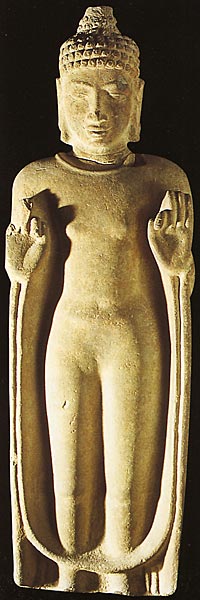
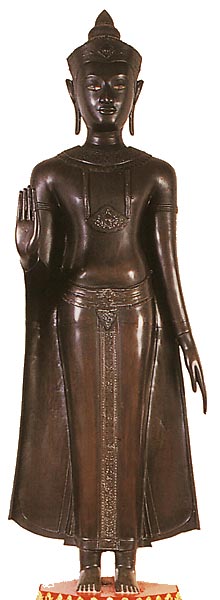
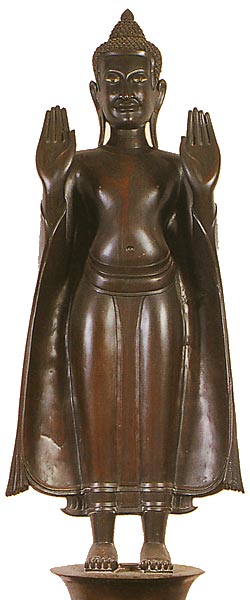
So, initially the faces depicted would resemble Indian sculptures. Later on, influenced by local styles, the aureole would appear in a lotus bud shape or orb over the cranial protuberance. Large hair curls are visible, and the eyebrows would resemble a crows wings curve, like a flying bird. Protuding eyes, with flat nose and thick lips are common. Standing Buddha images performing the Vitarka (Preaching) posture, with robes hanging to mid shin level (see example). In sitting images, a short mantle is placed over the left shoulder.
Khmer influence became visible later on with a more square face and cleft chin.

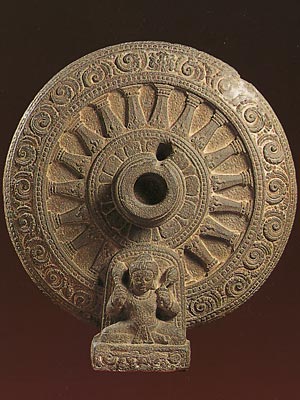
The Dharmachakra wheel (see picture at bottom) is very typical of Dvaravati art. The wheel was likely positioned on large pillars at places of worship. The Dharmachakra wheel symbolizes the Buddha's turning of the Wheel of Truth or Law. Often the Dharmachakra has eight spokes, symbolizing the eight-fold Noble Path. The Buddha is known as the Wheel-Turner : the One who sets the cycle of teachings in motion and in consequence changes the course of destiny.
It is worth remembering that during the early centuries of Buddhism, no sculptures of the Buddha were made, and the Buddha was represented by various symbols such as the Dharmachakra, the Bodi Tree, the Buddha's footprints etc.
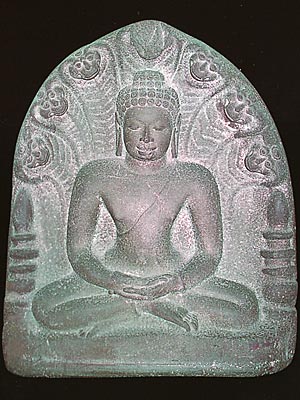
Dvaravati Art, Buddha Images, Meditation

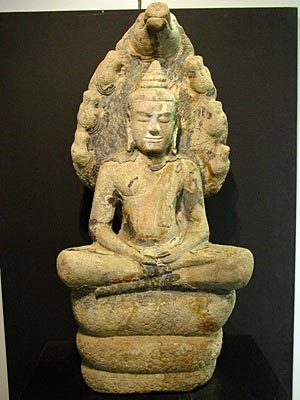
Dvaravati art - Buddha, protected by Naga in meditation posture. 8 - 11 th century A.D.
Found at Si Mahosot, Prachinburi province.
Now in the National Museum, Bangkok.

Dvaravati Art, Vitarka Mudra, Prachinburi, Buddha Images
Dharavati art - Standing Buddha with two hands displaying Vitarka Mudra. 7- 9 th century A.D.
Found at Si Mahosot.
Now present at National Museum, Prachinburi.

Buddha Images, Meditation, Dvaravati Art, Buddha Iconography
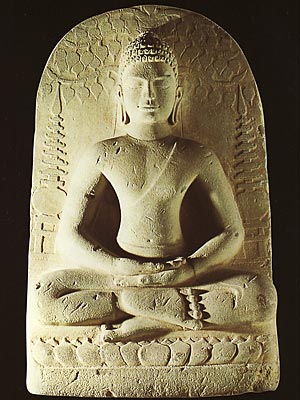
Dvaravati art - Sitting Buddha in Meditation Posture.
8 - 10th century A.D.
Found at Si Mahosot, Prachinburi province.
Now present at National Museum, Prachinburi.

Teaching, Buddha Images, Dvaravati Art, Buddha Images
Stone carving of scene from the Buddha's life. Dvaravati art 7th-11th century A.D. The Lord Buddha is seated in so-called 'European' fashion.
Phra Pathom Chedi National Museum (Nakhon Pathom)
Original found at Wat Sai, Nakhon Pathom

Phra Pathom Chedi, Buddha Images
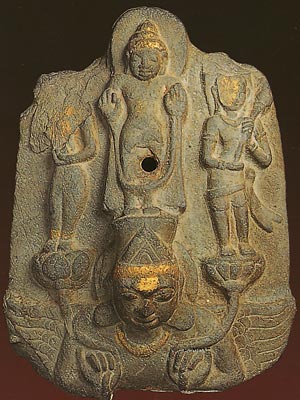
Dvaravati art - Buddha standing on Arunaditya.
7 - 11th century A.D.
Found at Nakhon Pathom.
Now present at Phra Pathom Chedi National Museum, Nakhon Pathom.

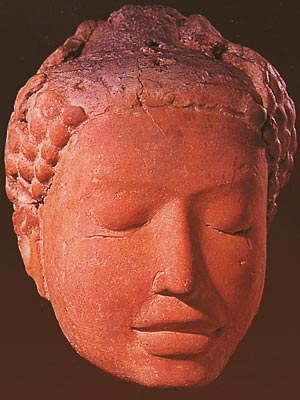
Head of the Buddha, Dvaravati Art
Dvaravati art - Head of the Buddha
17 cm high Terracotta image.
Found at Wat Phra Ngam, Nakhon Pathom.
Now present National Museum, Bangkok.

Dharmachakra Wheel, Dvaravati Art
Dvaravati art - Dharmachakra
7- 11th century A.D.
Found at Nakhon Pathom.

Khmer-Lopburi

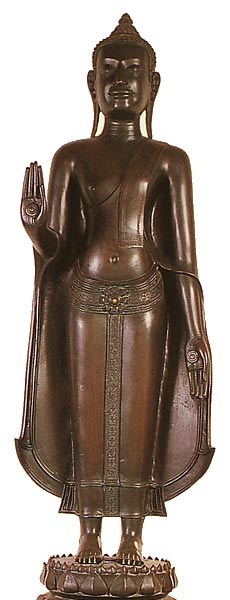
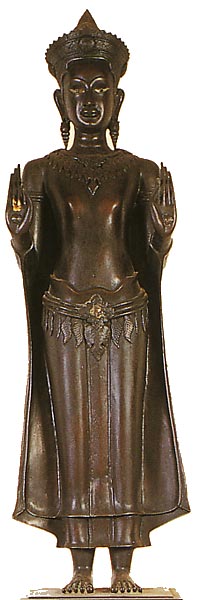
Lopburi art goes back to the 11-13th century A.D. Lopburi was a provincial capital during the Khmer empire. At times it experiences periods of independence, but its art form and Buddha images display Khmer influence.
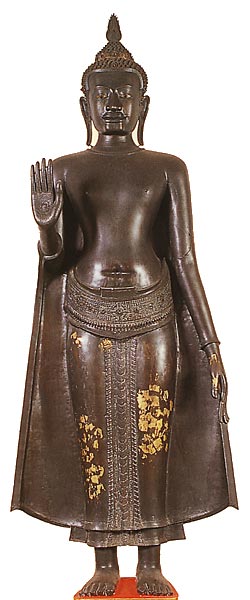
Buddha images often display a cranial protuberance in the form of three tiered lotus petals. A hair band is featured, and the hair of the Buddha can be straight like human hair. The head is often decorated with a diadem of face frame. Thick lips, a smiling face, prominent earlobes are featured.
A robe is draped diagonally with a straight edged mantle over the left shoulder, extending to the navel. Often the Buddha image is displayed on a lotus petal base. Seated Naga protected Buddha images in the meditation posture are common. Sometimes the Naga protected Buddha appears with Royal ornaments, and has a more stern facial expression.

Ching Saen-Lanna
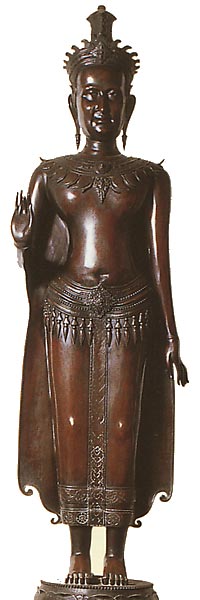
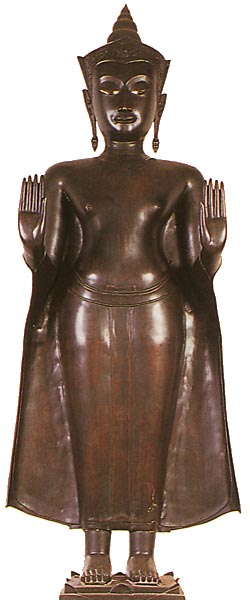
Standing Buddha Lopburi style
Buddha, wearing the attributes of Royalty, in the Khmer style of the Lopburi period.
With the gesture (see right hand) of preaching. Cast and enlarged from an old model.
Image present in the cloister of the Ubosoth at Wat Benchamabophit, Bangkok.

Standing Buddha Lopburi style

Standing Buddha image, with the gesture of forbidding the relatives from fighting.
In the style of the Lopburi period.
Found in Phetchaburi province.
Image present in the cloister of the Ubosoth at Wat Benchamabophit, Bangkok.

Sitting in Meditation, Khmer style, Buddha image with Naga

National Museum Prachinburi
Naga protected Buddha image. Notice the cranial protuberance in the form of three tiered lotus petals.

Subduing Mara, Khmer style, Wat Benchamabophit
Sitting Buddha with the gesture of Subduing Mara.
In the Khmer style.
Found at Wat Si Chin, Thonburi.
Image present in the cloister of the Ubosoth at Wat Benchamabophit, Bangkok.

Lopburi style Buddha Image
Standing Buddha image, with the gesture of Forbidding the Relatives from Fighting.
In the style of the Lopburi period.
Cast and enlarged from an ancient model.
Image present in the cloister of the Ubosoth at Wat Benchamabophit, Bangkok.

Standing Buddha, Forbidding the Relatives from Fighting

Standing Buddha image, with the gesture of Forbidding the Relatives from Fighting.
In the style of the Lopburi period.
Cast and enlarged from an ancient model.
Image present in the cloister of the Ubosoth at Wat Benchamabophit, Bangkok.

Standing Buddha, Calming the Ocean

Standing Buddha, with the gesture of Calming the Ocean.
In the style of the Lopburi period.
Cast and enlarged from an ancient model.
Image present in the cloister of the Ubosoth at Wat Benchamabophit, Bangkok.

Standing Buddha, Lopburi style, Caliming the Ocean

Standing Buddha image, with the gesture of Calming the Ocean.
In the style of the Lopburi period.
Cast and enlarged from an ancient model.
Image present in the cloister of the Ubosoth at Wat Benchamabophit, Bangkok.

Standing Buddha image, with the gesture of Calming the Ocean.
In the style of the Lopburi period.
Cast and enlarged from an ancient model.
Image present in the cloister of the Ubosoth at Wat Benchamabophit, Bangkok.

Standing Buddha Image, Calming the Ocean

Standing Buddha image, with the gesture of Calming the Ocean.
In the Khmer style of the Lopburi period.
Cast and enlarged from an ancient model.
Image present in the cloister of the Ubosoth at Wat Benchamabophit, Bangkok.

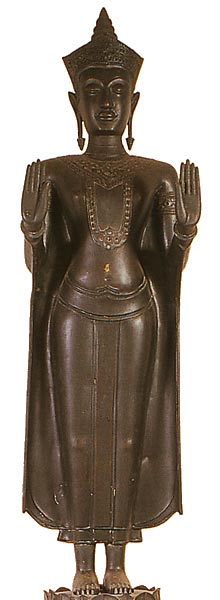
Standing Buddha Image, Royal Attire, Lopburi Style

Standing Buddha image, with the gesture of Forbidding the Relatives from Fighting.
Wearing the attributes of Royalty.
In the style of the Lopburi period.
From Wat Tewarat, Bangkok.
Image present in the courtyard behind the Ubosoth at Wat Benchamabophit, Bangkok.

Sukhothai

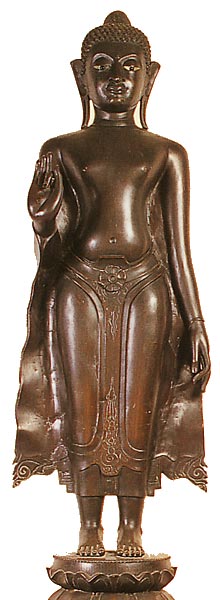
The Kingdom of Sukhothai had important contacts with Sri Lanka. Thai monks travelled to Sri Lanka for further religious instruction, and Sri Lankan monks settled in Sukhothai. Sukhothai religious art was thus influenced by Sri Lankan art. The Buddha images of the Sukhothai era gained important disdinguishing characteristics from the images during the Khmer and Mon era.
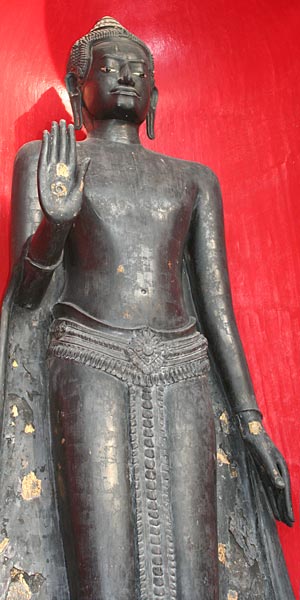
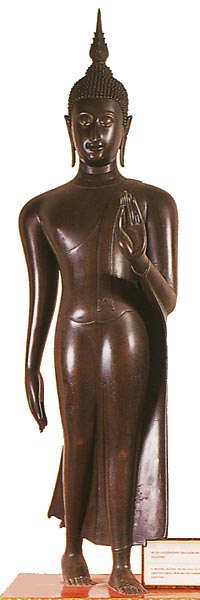
A flame appeared on top of the head of the Buddha. The head is covered with fine curled hair. The face is oval, with high curving eyebrows, a hooked nose, a downward gaze, and overall displays a gentle smiling expression.
The body of the Buddha images displays broad shoulders and a small waist.
Overall it can be said that the Buddha Images do not appear human, but display idealistic or superhuman characteristics.
During the Sukhothai era, the four postures of the Buddha (sitting, standing, walking, reclining) were created.
Buddha images of the Sukhothai era are subdivided in several groups.
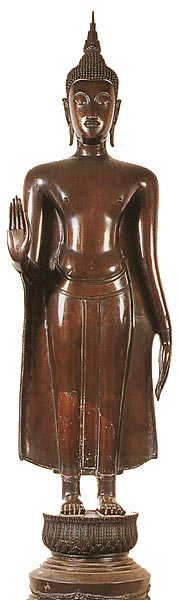
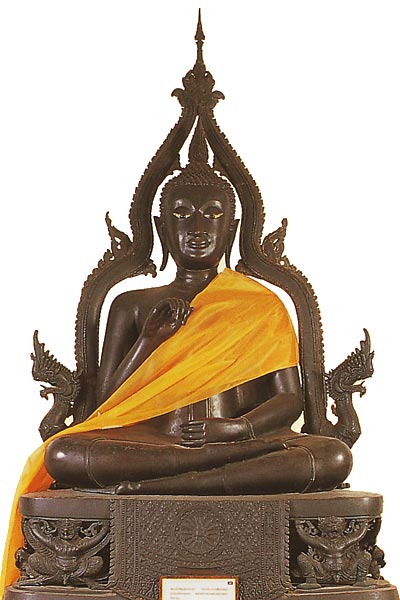
The image right below here displays Phra Phuttha Chinnarat image in Phitsanulok. It belongs to the Phra Phuttha Chinnarat group of images. Notice that the face is more rounded with a flame shaped aureole. The fingers on each hand are of equal lenght.

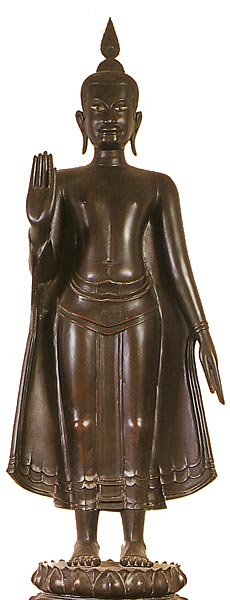
Sitting Buddha images of the Sukhothai period most often display meditation posture, or the gesture of Subduing Mara. Walking Buddhas display the gesture of dispelling fear (Abhaya Mudra), or giving instruction (Vitarka Mudra).

Phra Phuttha Chinnarat, Phitsanulok, Sitting Buddha Image, Subduing Mara
Phra Phuttha Chinnarat at Wat Phra Sri Rattana Mahathat in Phitsanulok.
This Buddha image is generally regarded to be the 'second most' important Buddha image in Thailand.
[The Emerald Buddha at Wat Phrakaew in Bangkok is probably the most important]
A replica of Phra Phuttha Chinnarat is present as the main Buddha image at Wat Benchamabophit in Bangkok.

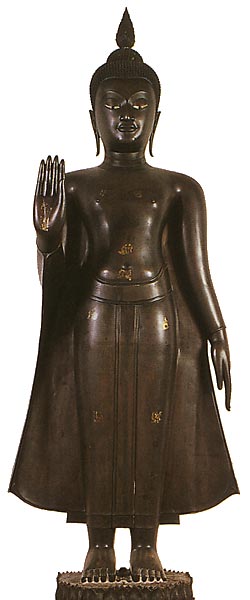
Standing Buddha, Sukhothai Style
Standing Buddha, with the gesture of forbidding the relatives from fighting each other.
In the style of the Sukhothai period.
Found at Wat Bang Oi Chang, Nonthaburi province.
Image present in the cloister of the Ubosoth at Wat Benchamabophit, Bangkok.

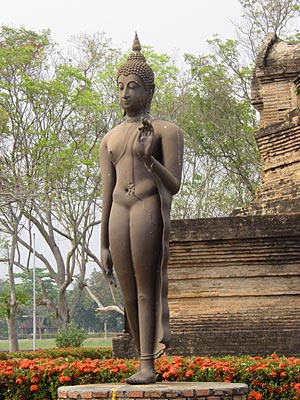
Walking Buddha, Sukhothai Style
Walking Buddha, Sukhothai Historical Park

Standing Buddha, Sukhothai Style, Wat Benchamabophit

Standing Buddha image, with the gesture of Forbidding the Relatives from Fighting.
In the style of the Sukhothai period.
Found at Wat Mai Nakhon Luang, Ayutthaya province.
Image present in the cloister of the Ubosoth at Wat Benchamabophit, Bangkok.

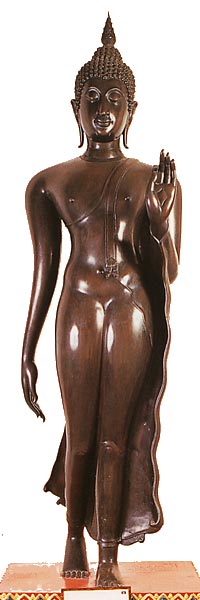
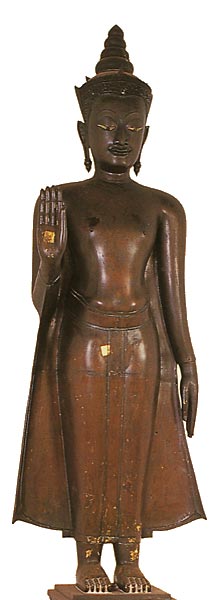
Walking Buddha, Sukhothai Style

Walking Buddha image with the gesture of Imparting Fearlessness.
In the style of the Sukhothai period.
From Wat Mahathat, Bangkok.
Image present in the cloister of the Ubosoth at Wat Benchamabophit, Bangkok.

Walking Buddha, Sukhothai Style

Walking Buddha, with the gesture of Imparting Fearlessness.
In the style of the Sukhothai period.
From Wat Ratchathani, Sukhothai province.
Image present in the cloister of the Ubosoth at Wat Benchamabophit, Bangkok.

Standing Buddha Image, Sukhothai Style

Standing Buddha image, with the gesture of Imparting Fearlessness.
In the style of the Sukhothai period.
Cast and enlarged from an ancient model.
Image present in the cloister of the Ubosoth at Wat Benchamabophit, Bangkok.

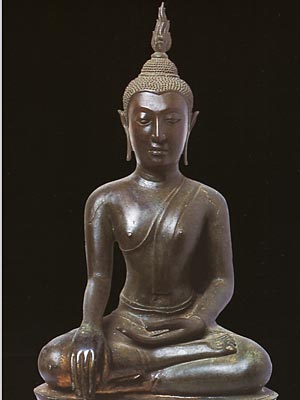
Sitting Buddha, Sukhothai Style, Subduing Mara

Sitting Buddha image, with the gesture of Subduing Mara.
In the style of the Sukhothai period.
Found at Wat Praya Krai (Jotanaram), Bangkok.
Image present in the cloister of the Ubosoth at Wat Benchamabophit, Bangkok.

Sukhothai Style Sitting Buddha, Subduing Mara, National Museum Prachinburi

Buddha Image with the Gesture of Subduing Mara.
(15th century A.D.)
National Museum Prachinburi

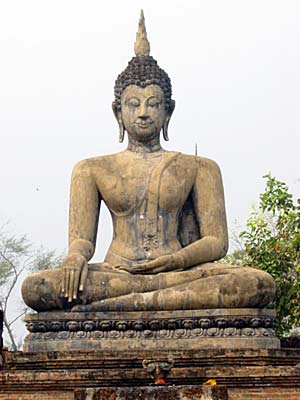
Buddha at Wat Mahathat, Sukhothai, Thailand
Buddha at Wat Mahathat, Sukhothai


U thong

U Thong art flourished in Central Thailand between the 12-15th century A.D. in the period when Khmer influence was diminishing or disappearing and before and during the early stages of the Ayutthaya Kingdom. As such U Thong style was influenced by previous and contemporary styles in the region.
Depending on prevailing influences and the time frame, U Thong Buddha images are often subdivided into three groups.
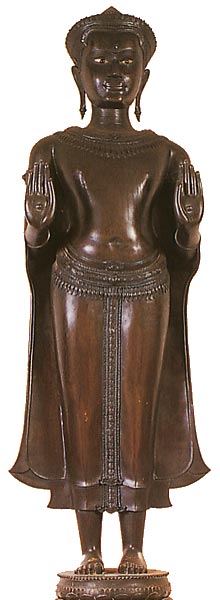
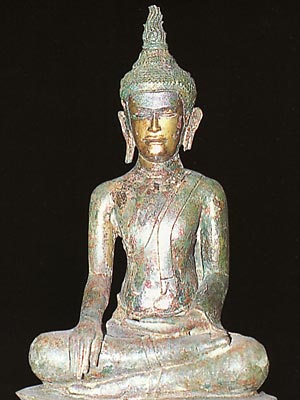
Typical of U Thong Buddha images is a small band between the hairline and the forehead. The head features small curls. The face of the Buddha image is rather square with Mon and Khmer characteristics. During the early period the ushnisha (prominent bump on the top of Buddha's head) is topped by a lotus bud. In later period (Sukhothai influence), this is replaced by an elongated flame. The face became more oval later on, and the body more elongate under the influence of the Sukhothai style.
The eyes are cast (not inlaid as often the case with images of the Ayutthaya period).
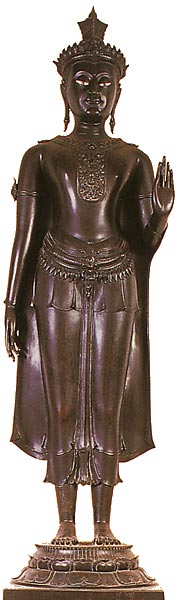
The robe is draped in the open mode with a long flap over the left shoulder (see image below) ending above the navel.
U Thong style Buddha images mostly display the gesture of Subduing Mara in the sitting position, and the gesture of Dispelling Fear (Abhaya Mudra) in the standing position.

Sitting Buddha Image, Meditation, U-Thong Style
Bronze Buddha Subduing Mara
2nd period of U-Thong Style, 15th Century
From Wat Mahathat ,Sukhothai
Presently at Ramkhamhaeng National Museum, Sukhothai

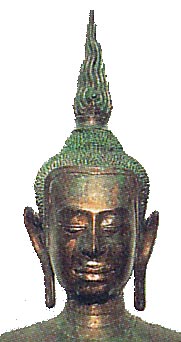
Head of Buddha Image, U-Thong Style
Bronze Buddha Subduing Mara, detail.
2nd period of U-Thong Style, 15th Century. Notice the band between the hairline and the forehead.
From Wat Mahathat ,Sukhthai
Presently at Ramkhamhaeng National Museum, Sukhothai

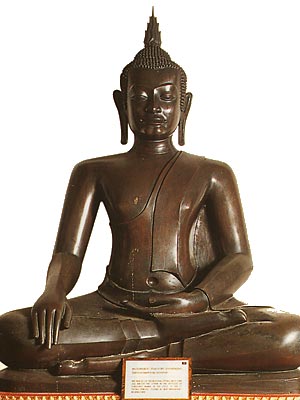
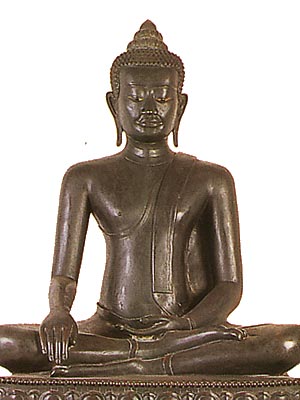
Subduing Mara, U-Thong Style Sitting Buddha Image

Sitting Buddha image, with the gesture of Subduing Mara.
In the style of the U-Thong period.
Found at Wat Mahathat, Muang San, Chainat province.
Image present in the cloister of the Ubosoth at Wat Benchamabophit, Bangkok.

Sitting Buddha Image, Subduing Mara, U-Thong Style
Sitting Buddha with the Gesture of Subduing Mara. In the style of U Thong, later period, showing influence of Sukhothai art. (16th century A.D.)
National Museum Prachinburi

Sitting Buddha, Subduing Mara, U-Thong Style

Sitting Buddha image, with the gesture of Subduing Mara.
In the style of the U-Thong period.
Cast and enlarged from an ancient model.
Image present in the cloister of the Ubosoth at Wat Benchamabophit, Bangkok.

Standing Buddha, U-Thong Style

Standing Buddha image, with the gesture of Forbidding the Relatives from Fighting.
In the style of the U-Thong period.
Cast from a model at Wat Rajathiwat, Bangkok
Image present in the cloister of the Ubosoth at Wat Benchamabophit, Bangkok.

Standing Buddha, U-Thong Style

Standing Buddha image, with the gesture of Forbidding the Relatives from Fighting.
In the style of the U-Thong period.
Found at Wat Ratchathani, Sukhothai province.
Image present in the cloister of the Ubosoth at Wat Benchamabophit, Bangkok.

Sitting Buddha, Subduing Mara, U-Thong Style

Sitting Buddha image with the gesture of Subduing Mara. In the style of U Thong, middle period. Influenced by Khmer art. (13-14th century A.D.)
National Museum Prachinburi

Ayutthaya

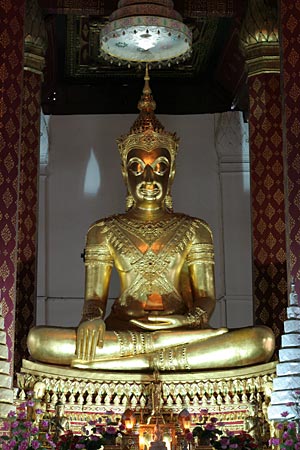
Main Buddha Image at Wat Na Phramen, Ayutthaya. Subduing Mara. Royal Attire.
Main Buddha Image at Wat Na Phramen, Ayutthaya. Hands display the gesture of Subduing Mara. The Buddha is in Royal Attire, with a prominent Head Dress or Crown. Typical of the late Ayutthaya period.


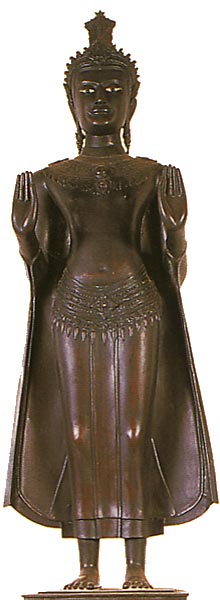
Buddha images of the Ayutthaya period show more different gestures than the other previoius styles. The images display the influence of Lopburi, U Thong and Sukhothai styles.
Initially the face may be more square, and a band (U Thong influence) may be present between the hairline and the forehead. Later on (Sukhothai influence) the face became more oval, with a Sukhothai type of flame on top of the ushnisha (prominent bump on the top of Buddha's head). Typical of some images are small lines carved above the upper lip and above the eyes.
Later on also, the facial expression became more stern, sometimes without any smile at all. In the later period, it became also common to show the Buddha wearing a lot of ornaments. One type shows the Buddha with an Emperor's attire (the Thai language term refers to 'big ornamentation') or with a somewhat more modest attire ('small ornamentation') featuring a crown or diadem. See examples especially at bottom of this page.

Buddha images of this period display many gestures and postures. Standing images (as featured below) often display the gesture of Dispelling Fear (Abhaya Mudra). Sitting images often display the gesture of Subduing Mara. Some giant Reclining Buddhas were constructed during this period.

Buddha Images Ayutthaya, Calming the Oceans
Standing Buddha, with the gesture of Calming the Oceans.
In the style of the Ayutthaya period.
Found at Wat Yai, Phetchaburi province.
Image present in the cloister of the Ubosoth at Wat Benchamabophit, Bangkok.

Ayutthaya Buddha Images

Standing Buddha, with the gesture of Calming the Oceans.
In the style of the Ayutthaya period.
Found in Phetchaburi province.
Image present in the cloister of the Ubosoth at Wat Benchamabophit, Bangkok.

Prachinburi, Calming the Ocean, Buddha Images

Standing Buddha image with the Gesture of Calming the Ocean.
Ayutthaya Style. The Buddha is in Royal Attire. (16-17th Century A.D.)
National Museum Prachinburi

Ayutthaya Buddha Image
Standing Buddha image with the gesture of Calming the Ocean.
In the style of the Ayutthaya period.
Found in Phetchaburi province.
Image present in the cloister of the Ubosoth at Wat Benchamabophit, Bangkok.

Ayutthaya Buddha Images
Standing Buddha image, with the gesture of Calming the Ocean.
In the style of the Ayutthaya period.
Found in Phetchaburi province.
Image present in the cloister of the Ubosoth at Wat Benchamabophit, Bangkok.

Ayutthaya, Forbidding the Relatives from Fighting, Buddha Images
Standing Buddha image, with the gesture of Forbidding the Relatives from Fighting.
In the style of the Ayutthaya period.
Found at Wat Yai, Phetchaburi province.
Image present in the cloister of the Ubosoth at Wat Benchamabophit, Bangkok.

Ubosoth, Wat Benchamabophit, Buddha Images
Sitting Buddha image, with the gesture of Invoking Victory.
In the style of the Ayutthaya period.
Cast from an ancient model.
Image present in the cloister of the Ubosoth at Wat Benchamabophit, Bangkok.

Standing Buddha Image, Ayutthaya style, Calming the Ocean

Standing Buddha image, with the gesture of Calming the Ocean.
In the style of the Ayutthaya period.
Found in Phetchaburi province.
Image present in the cloister of the Ubosoth at Wat Benchamabophit, Bangkok.

1 comment:

Cultorweb said...

We would like to translate this article in italian for our site:
http://www.cultor.org/Orient/lindex.html.
If you send me your email I will reply with all details.

Thanks
Paolo Pierleoni
info@cultor.org